Wall Mural Ideas That Make Any Room Feel Bigger

By Dipan Patel
Small rooms do not always need more square footage. Often they just need the right wall to open up. A large-scale mural pulls the eye deep into a scene, which makes the room read as wider and taller than it really is. If your flat feels a little boxed in, a well-chosen wall mural wallpaper can shift how big a space feels without moving a single piece of furniture.
A wall mural makes a room feel bigger by adding depth, perspective, and light through one large image. Scenic and misty designs create the strongest illusion of space. Giffywalls murals are made to measure, so the artwork fits your wall edge to edge with no awkward gaps or repeats.
How does a wall mural make a room feel bigger?
A wall mural makes a room feel bigger because it adds visual depth that a flat painted wall cannot. When your eye follows a path, a horizon, or fading mist into the distance, the wall stops feeling like a hard boundary and starts feeling like a window. That borrowed distance is why designers reach for scenic murals in compact homes.
Unlike a plain wall wallpaper in a single flat colour, a scenic mural gives your eye somewhere to travel. The further the scene appears to stretch, the more the room takes on that imagined space.
Which mural designs create the most depth?
Murals with a clear foreground, middle ground, and background create the most depth. Forest trails, misty valleys, and open skies all carry the eye toward a vanishing point, so the wall reads as far away rather than close. Nature scenes work especially well because we already read them as wide, open spaces.
A calm wallpaper of beautiful nature does more than decorate. Rolling greenery, soft light, and a hazy horizon make the strongest case for openness in a small room, especially when the softest part of the scene sits toward the centre of the wall.
What colours help a small room open up?
Light and cool colours help a small room open up the most. Soft greens, misty blues, pale pinks, and off-whites bounce more light around and visually push walls back. Warmer, darker tones feel cosy and grounded, but they tend to pull walls inward, which suits larger rooms far better than tight ones.
For a soft, airy feel, a pale rose wallpaper keeps a bedroom light without washing it out. Muted floral tones sit gently against neutral furniture and reflect light through the day, which quietly stretches the room. Save bold, saturated murals for a large living room where the wall can carry that weight.
Where is the best wall for a mural?
The best wall for a mural is the first one you see when you walk into the room, usually the wall facing the doorway. Putting your depth and horizon here means the room opens up the moment you step inside, before the eye notices how small the floor space is.
A leafy scene like tropical wallpaper for walls turns that facing wall into a feature without cluttering the room. Leave the side walls plain and let the mural do the talking, since one strong focal wall almost always reads as more spacious than four busy ones.
Which made-to-measure murals add the most space?
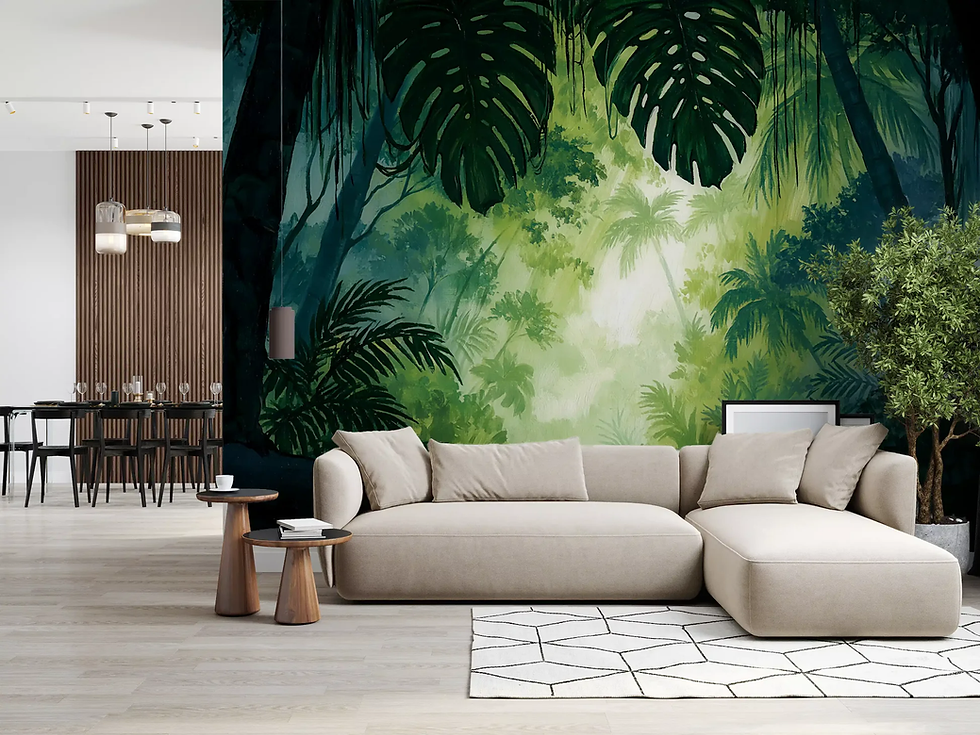
The Misty Tropical Rainforest Canopy is a smart pick when you want a small room to breathe, because its soft mist and layered greenery fade back into the wall and build real distance. Made to measure, it runs unbroken from corner to corner and sits flush against your exact wall size.
The Dreamy Pastel Floral Canopy leans light and delicate, so it lifts a small bedroom or hallway without dominating it. Its pale, blossom-heavy wash keeps the palette gentle and the mood spacious, which is exactly what a tight room needs.

The Soft Watercolor Poppy Meadow leans light and airy, so it lifts a compact bedroom or hallway without dominating it. Its pale, painterly wash keeps the palette gentle and the mood spacious, which is exactly what a tight room needs.

Can mural depth work in a pooja room too?
Yes, a gentle mural can make even a compact pooja room feel calmer and more open. Light, soft-toned backdrops add a quiet sense of space behind the mandir without crowding a small area or fighting with diyas and decor.
A subtle pooja room wallpaper in cream, pale gold, or soft green keeps the corner peaceful while making the wall feel further away. The aim is a serene, breathable backdrop that supports the space rather than dominating it.
Conclusion
Making a room feel bigger is mostly about how you use the walls, not how much floor you have. A mural with depth, light colours, and a single well-chosen focal wall can open up a small flat far more than another shelf or mirror ever could. Pick a scene that fades into the distance, keep the tones soft, and let one wall carry the whole effect.
FAQ
Do wall murals really make a room look bigger?
Yes. A mural with a horizon or fading background adds depth that a flat wall lacks, so the room reads as wider and taller. Light colours and a single focal wall push the effect further and stop the space from feeling closed in.
Which mural colours are best for small rooms?
Soft, cool, and light shades work best. Misty blues, pale greens, off-whites, and muted pinks reflect light and visually push walls back. Dark, warm tones feel cosy but tend to shrink a small room, so keep those for larger spaces.
Where should I put a mural in a small room?
Put it on the wall you see first when you enter, usually the one facing the door. Keep the other walls plain so the mural stands out as a single focal point, which reads as more open than covering every wall.
Can I get a mural sized for my exact wall?
Yes. Giffywalls murals are made to measure, so you enter your wall width and height and the design is printed to fit. This keeps the scene running edge to edge with no repeats, gaps, or awkward joins.


Comments